le nozze di figaro
den norske opera | 2026
conductor
set and costume design
video design
lighting
dramaturgy
production photos
promotional photos
Ottavio Dantone
Katrin Lea Tag
Clemens Walter
Ellen Ruge
Hedda Høgåsen-Hallesby
Erik Berg
Anja Niemi



PRESS:
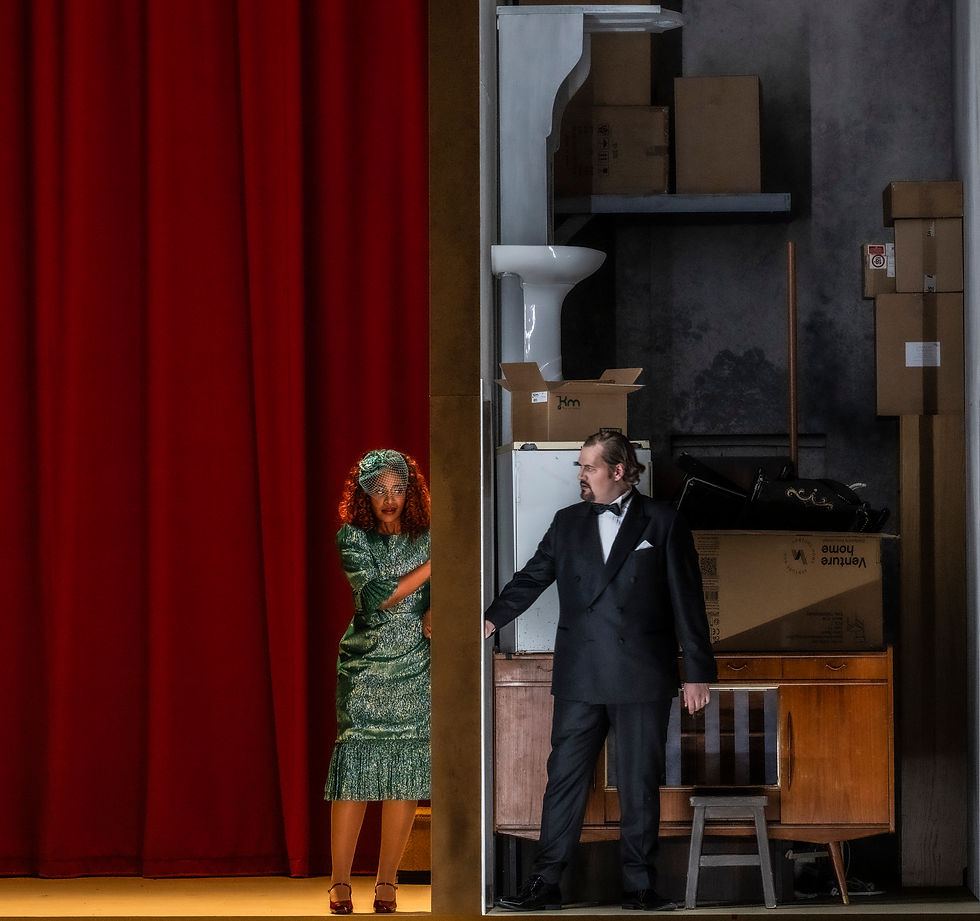
"Director Matthew Wild turns Mozart’s The Marriage of Figaro into contemporary drama without losing the essence of the work. ... Wild knows how to balance pathos ... A similar tension between playfulness and seriousness, dream and everyday life, is found in Katrin Lea Tag’s fine and functional set design ... The narrow, overcrowded storage room points toward the asymmetrical conditions under which aristocracy and servants lived. It creates physical resistance for everyone trying to manoeuvre through the clutter. The room is also strange enough to remind us that opera is a game ... All in all, this is highly successful ... The production shows a genuine interest in the work’s own time and how it can resonate with ours. As I sit in the auditorium, it strikes me that, on one level, the world has changed very little in 240 years. Low-paid cleaners are currently on strike, and it is not long since we needed a massive reckoning with sexual harassment by bosses. But to be able to make such associations from a production that takes the work’s 18th-century setting seriously, is a gift." Hild Borchgrevink DAGSAVISEN
"Director Matthew Wild has solved the puzzle in a superb and unexpected way – by creating an indeterminate dream-like world where time and place seem subordinate and fluid, while many realistic elements are at play. Both the set and costume design are by Katrin Lea Tag, and it is as if the stage images depict a place that tries to appear real, but which nevertheless is not ... The production has delved deep into the darkness of the music, and both a dead and an unborn child have been written in. Susanna is expecting a child with Figaro – a not uncommon reason for hasty marriage in earlier times. At the same time, it is more than implied that the Count and Countess have previously lost a child ... The dark backdrop is on a total collision course with the broad comedy, but the flexible, imaginative stage space has room for both, and often one is unsure whether to laugh or cry ... Wild is not only a director who manages to create coherent ideas, but he has also got the performers to adopt a complete acting style" Hilde Halvorsrød SCENEKUNST.NO
"Mozart’s The Marriage of Figaro constantly balances between comedy and tragedy. When South African director Matthew Wild stages the opera in Bjørvika, it is the tragic human destinies that take centre stage. Wild’s interpretation highlights interesting aspects of Mozart’s comedy, and with a consistently brilliant cast of soloists, he pulls it off almost perfectly ... The Count and Countess’s childlessness is contrasted by Susanna and Figaro. Throughout the opera, it is made clear that Susanna is pregnant, and the contrast between the two couples creates an interesting dynamic. It is in the melancholic moments that Wild succeeds best, with flashbacks both on video (designed by Clemens Walter) and on stage ... The Opera has put together a brilliant ensemble of singers." Aksel Dalmo Tollåli AFTENPOSTEN
"Matthew Wild's production is highly intelligent and highly successful: the stage space is divided into three - the Countess's bedroom on the left, the Count's study on the right, and squeezed between the two is a small closet, crammed with a thousand objects, intended to be "the most comfortable room in the palace," the one intended for Susanna and Figaro. A modern setting, with a few 1970s touches, which also intelligently embraces the nocturnal and external space of the fourth act, as the aforementioned study is invaded by a large stone structure (evoking the Sacred Wood of Bomarzo) and enhanced by a fitting play of light. At the centre of the drama is a child: he is likely the son of the Countess and the Count (during the Overture we see a short film of their wedding), but also, prospectively, that of Susanna (who is pregnant) and Figaro. Very discreetly, he pulls the strings of the opera, providing a privileged point of view. For the rest, Wild supports Da Ponte's perfect libretto without modernizing anxieties but emphasizing its subversive force, guiding the singers—all excellent actors—with a light hand"
Nicola Cattò MUSICA
"Wild's detailed stagecraft was always musically responsive ... For once, the use of video (designed by Clemens Walter) was absorbing and didn't detract from excellent work in the pit " John Allison OPERA MAGAZINE